Selling SaaS to the German Mittelstand is harder than you think
You have a category-leading SaaS product. It sells well in the US, the UK, the Nordics. You read a Bessemer post saying Germany is the next big market for vertical SaaS, you fly to Berlin for a week, you hire a sales rep on LinkedIn, you translate the homepage with DeepL. Six months later: three meetings, zero closed deals, and a sales rep telling you that „German buyers are slow.“
The buyers are not slow. The buyers are different. The Mittelstand — companies with 50 to 500 employees, family-owned, often third-generation, sitting in places like Bielefeld, Linz or Winterthur — buys software in a way that breaks every assumption a Silicon Valley playbook is built on. Long sales cycles. Procurement-heavy buying committees. A deep cultural preference for German-language vendors. GoBD, DSGVO, BSI-C5 compliance requirements that read like alphabet soup until your deal stalls on them. A purchase decision that involves the GF (Geschäftsführer = managing director), the CFO, the IT-Leiter, and often a Procurement-Lead — all four have to nod, and any one of them can kill the deal.
This page is for the founders who suspect that — and are looking for someone who actually understands both sides of the equation: the SaaS playbook on one side, the German Mittelstand buying culture on the other. That someone is me. Barnd Duong. Native German speaker, born and raised in Germany, 15+ years in industrial B2B sales and warehouse management before pivoting full-time into SEO and content for B2B SaaS vendors. Industrial-B2B background.
„An agency without the agency. One person who gets the whole party running — a direct path from indie SaaS to scalable revenue.“
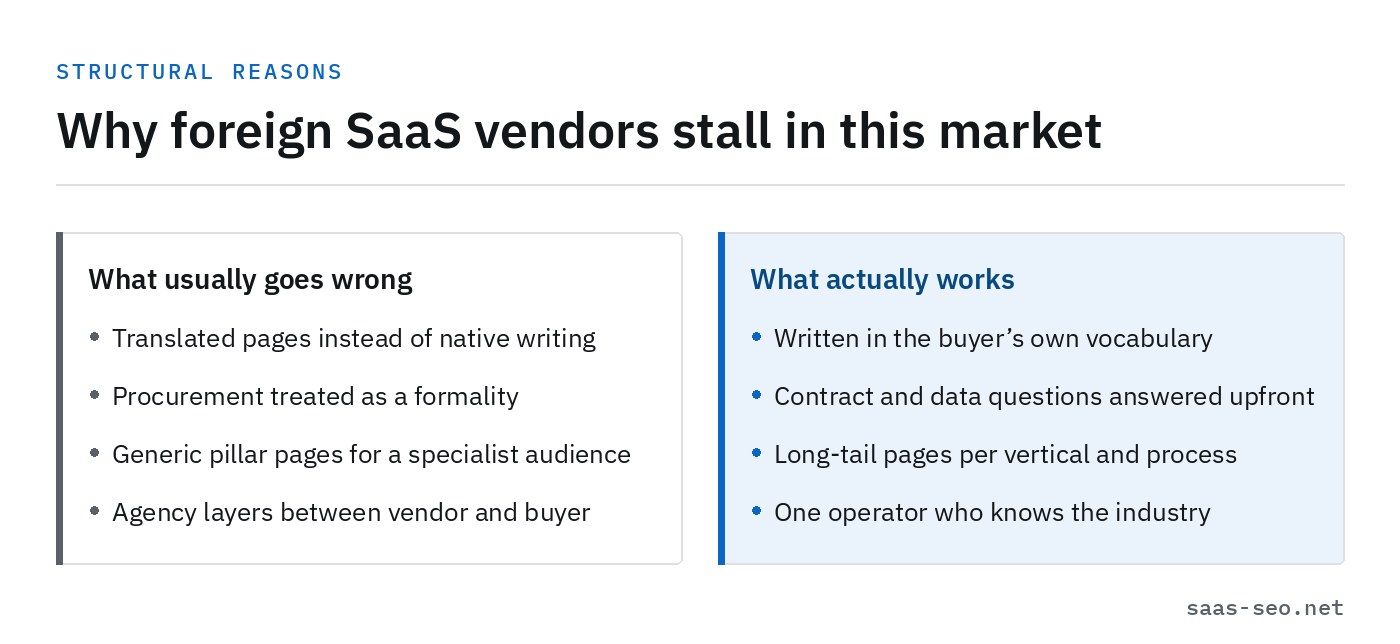
Why foreign SaaS companies fail (the three structural reasons)
1. The German-language gap is bigger than translation
You can DeepL-translate your landing pages. Your buyers will still smell it. German B2B copy follows different conventions than English: longer sentences, less hype, more concrete domain vocabulary, no „crushing it“ or „10x“ or „skyrocketing.“ A German Mittelstand CFO reading translated US-startup copy thinks — correctly — that the vendor doesn’t understand the market. The conversion gap between native-German and translated copy on the same product is typically 3–5x in B2B-. That gap closes very, very slowly with translation alone.
2. Procurement is heavy, and procurement queries are different
Once a deal crosses about €25,000 annual contract valü, Procurement gets involved. Procurement does not search for „best CRM software.“ Procurement searches for things like „SaaS-Vertrag AV-Vertrag Muster DSGVO“ (SaaS contract DPA template GDPR), „BSI C5 Testat“, „Reverse-Charge USt“, „SaaS-Anbieter Insolvenz Ausstiegsklausel“ (SaaS vendor insolvency exit clause). If your site doesn’t rank for and answer these questions, your deal dies in the final stretch and you never find out why. Most US-built SaaS sites have zero content addressing this.
3. Long-tail vertical vocabulary, not generic pillar pages
The US SaaS playbook says: write one great pillar page („The Ultimate Guide to CRM“), build topic clusters around it, win at scale. In Germany it’s the inverse. A single English-language pillar page ranks for nothing meaningful. What ranks is 40 vertical landing pages, each speaking the precise vocabulary of one buyer segment: „ERP für Lebensmittelproduktion mit mehrstufiger Chargenverwaltung“ (ERP for food production with multi-stage batch management). That phrase has roughly 140 monthly searches. The buyer searching it has buying intent measured in weeks. Conversion rate from that long-tail term is 3–5x higher than from a generic „ERP software“ search. That is the structural lever, and it requires a Germany-native operator who knows the vocabulary.
What a local operator gets that tier-1 agencies miss
Generic SEO agencies — even good ones — scale by replacing domain knowledge with process. They have a CRM template, a SaaS template, an enterprise template. They produce content that reads like a process. Mittelstand buyers detect that in the first two paragraphs. The bar in B2B is not „well-written content,“ it’s „sounds like someone who has been in our industry for a decade.“
Three things change when the work is done by a native German speaker with industrial-B2B background:
- Vocabulary depth. A Mittelstand WMS-Anbieter (warehouse management SaaS provider) targeting pharma customers needs content that uses „GxP-Validierung,“ „Track & Trace,“ „GDP-konforme Kommissionierung,“ not „GMP-compliant order picking“ translated badly. I’ve sat in the warehouses where these things are operated.
- Buyer-coalition empathy. The buying committee — GF + CFO + IT-Leiter + Procurement — needs four different content angles on the same product page. I’ve sat across the table from each of them as a vendor, for 15+ years.
- Procurement compliance instinct. AV-Vertrag (DPA), GoBD-compliant document retention, BSI-C5 hosting, reverse-charge invoicing for B2B-EU customers — these are not afterthoughts, they are gating items. A local operator builds them into the SEO architecture from day one.
Twenty verticals covered — topical breadth as proof of expertise
The German-language side of saas-seo.net is a living proof-of-work: twenty industry-specific service landing pages plus fourteen long-form guides, each addressing one-vertical SaaS buying scenario. If you read German — or want to see what your translated content should look like in market — the German pages below are the reference. If you don’t read German, the count alone tells you the depth of vocabulary I bring to your account:
Each link opens the German-language version of that vertical service page, which is what your prospects will actually find when they search. If you commission new English-tier-1 content from me, this is the depth and structure I produce in your target verticals.
About Barnd — the bridge from industry to SEO
Fifteen-plus years in B2B industrial sales and warehouse management. Operations leadership in mid-size manufacturing and distribution. Hands-on SaaS implementations as the buyer-side ops lead, before I switched to the vendor side and now to the SEO-and-content side. I’ve sat across the table from every persona in a SaaS buying committee — as the vendor, as the buyer, and as the implementer. That perspective is rare and it’s the entire differentiation behind saas-seo.net.
I now operate solo from, Spain, through Sol del Lily S.L. (Spanish limited company, VAT ID ESB22879555). Reverse-charge invoicing B2B clients, monthly retainer model, no minimum lock-in beyond a calendar month. More personal background on the German Über-mich page (work-in-progress on the English equivalent).
How an engagement works
- €200 Strategy Call (1 hour) — we get on Zoom, you describe your product, ICP and ambition, I give you a candid market read, name the three fastest levers I see, and you decide if we work together. No obligation after the hour.
- Diagnosis & audit (weeks 1–2) — current SEO position, content gaps, technical debt, competitor landscape in your verticals, ICP-mapping. Documented.
- Strategy workshop (week 3) — 90-day content roadmap. Which verticals first, which procurement-content pieces, which migration-content angles. Clear keyword targets and conversion expectations.
- Execution (ongoing) — monthly retainer. Typical scope: 4–8 vertical landing pages plus 2–3 long-form guides per month, plus technical SEO maintenance. Cancellable month-to-month.
- Monthly review — what shipped, what moved, what’s next. One person, one report, no slide theater.
Who this is for — and who it isn’t
This is for you if
- You run a B2B SaaS or industrial software company with proven product-market fit in your home market, and is your next geo
- Your ACVs are in the €8K–€75K range and you can amortize SEO investment over a small number of won deals per year
- You want to talk to whoever is doing the work, not to someone relaying your questions who relays them to a writer
- You’re comfortable with a 6–12 month horizon to see SEO compound — not a 30-day quick fix
This is not for you if
- You sell consumer (B2C) products — different rules, different SEO
- You want a performance-marketing-led-entry (paid ads, programmatic) — I do SEO and content, not paid scaling
- You need an army of account managers and reporting dashboards — I’m one person, on purpose
- Your timeline expectation is „page-one rankings in 30 days“
Pricing in plain English
Independent consultant retainer for B2B-SaaS-SEO typically lands at €4,500–€9,000 / month, depending on scope (vertical-LP volume per month, technical migration, comparison and migration content, ROI-calculator builds, procurement-content). Comparable output from an agency usually runs 2–3x that — with lower domain depth. The €200 Strategy Call is the entry point: you get one hour of focused diagnosis and a candid go/no-go read, no obligation to continü.
One-time engagements (-entry audit only, or a single content sprint for a specific launch) are also possible — ping me with your situation.